A year ago Bob Lyons told The British Continental that road racing in the UK was “withering on the vine a bit”. He would not promise that his team would ride a full domestic season in 2026. He would wait, he said, “until we see the British calendar and how it all meshes”.
It meshed, after a fashion. Handsling Alba Development Road Team spent most of 2026 racing in Europe, and still started all eight rounds of the women’s National Road Series. It won one of them, was runner-up in the team standings, and took the National Circuit Series team title. It often did so with half a team, and Lyons is plain about the reason.
“The priority is Europe,” he says, but adds, “We will still be here [in the UK] and race.”
In the first part of this interview with The British Continental, Lyons explained how CAMS Alba’s 2027 squad came together and what its new sponsor’s money will pay for. In the second, he looks back at the 2026 season, and at a domestic scene he has not stopped worrying about.

Second to none
Lyons is emphatic about the year. “We had an exceptional season,” he says. “We delivered a race calendar that was second to none. There wasn’t another Conti team that had a race calendar like ours.”
ProCyclingStats lists Alba at more than 30 UCI races in 2026, among them the Tour of Britain Women, the Tour de Pologne, and ProSeries one-day races including Scheldeprijs and the Brabantse Pijl. Places in races at that level depend on invitations from organisers, and Lyons believes Alba has earned them by the way it rides. “We’re still at the behest of race organisers,” he says. “But we’ve now built those relationships, and we have a good reputation at a high level. We just turn up, we go there to race, and the result is not necessarily the most important thing. It’s how we race, and to get better at racing.”
There is a big result just around the corner
He does not oversell what came of it. “You might end up coming in 16th or 20th or something like that,” he says. “But the way individuals and the team rode was absolutely outstanding.” More than once during the season, he says, he predicted a breakthrough. “There is a big result just around the corner. It just needs all those critical bits, that fine line, to all come together.”
Asked for examples, he names two races where Alba came “just so close to it being very big”: the Bretagne Ladies Tour and Hageland. Kate Richardson was 5th and 10th on stages of the Bretagne Ladies Tour at the end of May, and 6th at Dwars door het Hageland three weeks later. In August Izzy Sharp was 5th in the prologue of the Giro della Toscana. “It’s a very fine line at that level,” Lyons says, “and we just didn’t quite get something right, or decision making at the right point, which would have made quite a big difference.”
At home, the team raced the Lloyds Tour of Britain Women, Britain’s only Women’s WorldTour race, where Alba’s place was confirmed only in July, after a year in which new UCI rules had threatened to keep Continental teams out. “We’re a British team, so yes, we very much want to do that,” Lyons says. “I don’t quite put so much weight on it as perhaps some of my peers in the UK, because it’s not the be all and end all. But it would be an absolute crying shame if that race goes ahead on UK soil and we’re not in it.”

Forty-three starts
At home, the clashes with UCI races showed. Alba made 43 starts across the eight rounds of the 2026 series, against 50 across seven rounds in 2025, from a squad of 13 and in a year when it had planned a fifth more race days. Only twice did it field a full complement of eight riders. At South Molton it started three.
British racing is important. It’s not in a great place, and we want to support it
“British racing is important,” Lyons says. “It’s not in a great place, and we want to support it.” The difficulty is the diary. Few rounds of the series, he explains, fell on a weekend when Alba was not also racing abroad, and who rode at home “depends on who’s racing where, what we’ve got coming up, how it fits into riders’ programmes”.
Next year will be no different. “We want to support the National Road Series. Europe will take priority,” he says. “We just need to manage that as best we can.” The extra staff that CAMS’s money will pay for will not change the sums. “We’re not gearing up for a dual programme,” he says. That, as he describes it, would mean “four cars, two mechanics’ trucks, two riders’ shuttles, six to eight DSs”. What Alba promises instead is to turn up. “When we do have a clash, we’ll get there in some way, shape, or form,” he says. “It’ll be a similar sort of thing.”
Alba cut back less than its biggest Continental rivals. Allowing for the extra round, it averaged just over five riders a round, down from seven. DAS–Hutchinson went from seven to under five, and Smurfit Westrock Cycling Team from nearly seven to under four. Both were at every round in both seasons. The fourth Continental team, O’Shea Red Chilli Bikes, which raced as CJ O’Shea Racing Team in 2025, kept to about two riders a round in both seasons, and missed two rounds in 2025 and one in 2026.
The biggest teams on the start line came from the tier below. FTP–Fulfil The Potential Racing made 55 starts, more than any other team and nearly twice as many as in 2025. Paralloy RT, which raced as Team Boompods in 2025, made 45. Paralloy is closing at the end of the year.
Lyons is quick to credit them. “Some of those development teams got good numbers, and they’re moving forward, and they’re doing things in the right way, which is fantastic,” he says. “That needs to be supported.”

A long way off, and very good
None of this is a verdict on the riders at the front of British races, and he is careful to say so. “It’s not so much British racing,” he says. Alba has stepped up to UCI racing, “and that is the level of racing we need. British national racing is not that level. It’s a long way off. It is very good, and it needs more support.”
The difference, as he describes it, is how far down the field the quality runs. “In the British National Series you’ve got exceptionally strong riders, what you tend to get is that the front end of the race is very, very strong,” he says. “You go to a UCI race, one of the bigger .2s in Belgium, and you’ve got 160 riders at that level.”
The open series, he thinks, has “much more depth”. It is in the women’s races that the gap shows. “If you compare a women’s British National Series road race to a women’s elite UCI .2 race, the gulf is enormous,” he says, “and that is fundamentally because of the depth of the field.”
British national racing is not that level. It’s a long way off. It is very good, and it needs more support
The domestic races still give Alba something the European ones do not. A year ago Lyons called them “a great proving ground or experimental ground”. He has not changed his mind. “The races are good,” he says. “We like to do them, because we do different things in those races, and it’s beneficial to us as individual riders and also as a team.”
The series is also where riders are found, and when that is put to him, he does not argue. “Oh, look, don’t get me wrong. I’m not belittling the National Road Series,” he says. It matters, he says, “for other riders coming through who may then be ready to make the next step”. Alba took Lily Martin on as a stagiaire weeks after she won the Lancaster Grand Prix for Loughborough Lightning. Kate Richardson, who won the Tour of the Reservoir for Alba in June, has gone further. Since part one was published, Lidl–Trek has named her in the first squad of its new development team, Lidl–Trek Future Racing Women.
The jewel of British road racing
What has changed since last year, in his view, is how few riders are on the start line. Field sizes in 2026, he says, were “alarmingly low”.
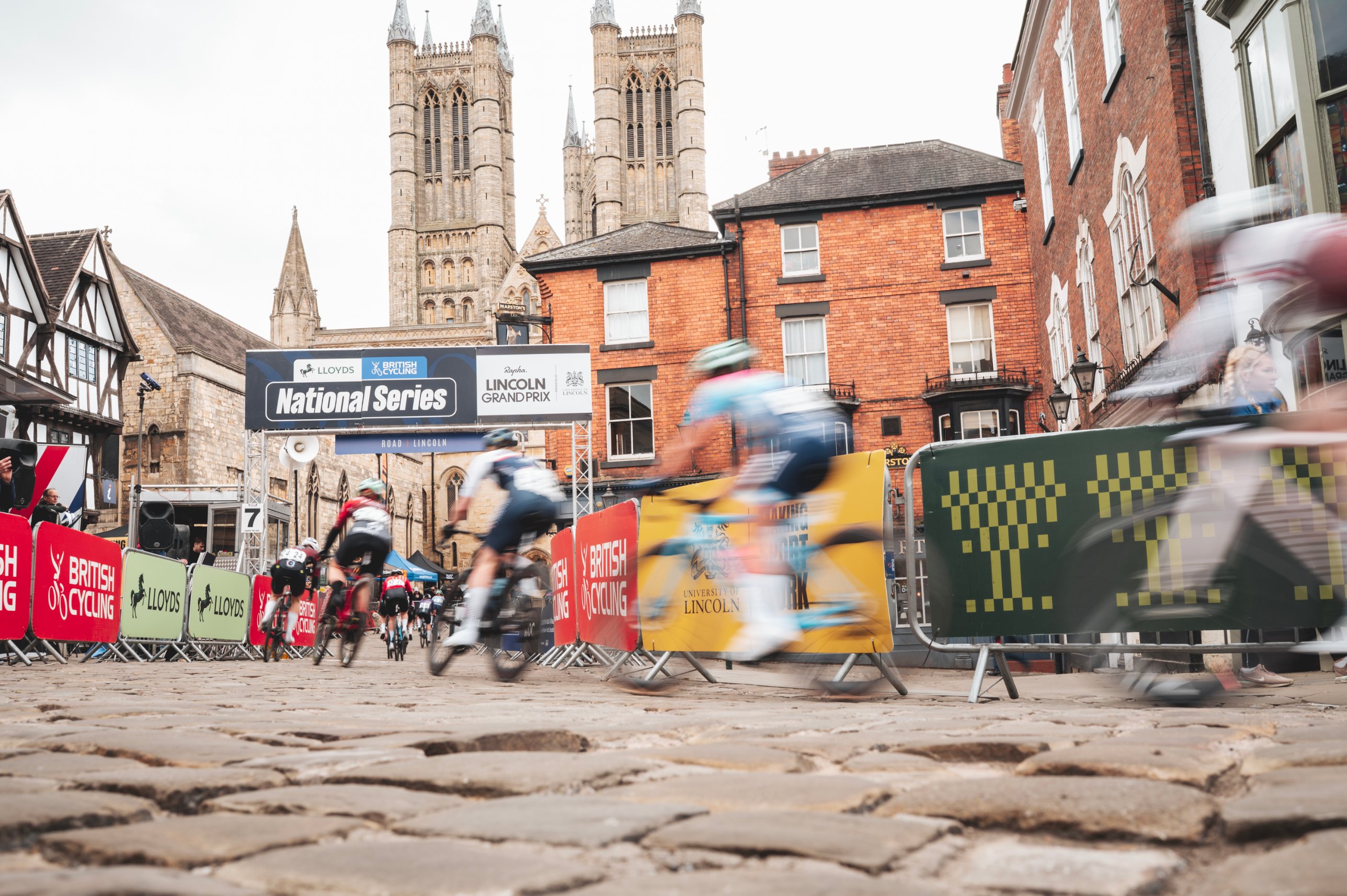
The official results bear him out. Counting finishers and non-finishers, the women’s series averaged 95 starters a round in 2024, 80 in 2025, and 69 in 2026. The biggest field this year was 97, at the women’s CiCLE Classic in March, and four of the eight rounds had fewer than 60.
“We need those fields back up to 120, 130,” Lyons says. By “we” he means “all the stakeholders in British cycling”. The figure is not nostalgia: the women’s CiCLE Classic had 119 starters in 2024.

Asked why the fields have shrunk, his first answer is a candid one. “I don’t know,” he says. “I think it’s just general. There’s an issue around female bike racing generally, certainly in this country.” It is, he thinks, worse here than abroad. “You can even look at club racing in continental Europe, and there’s pretty big fields.”
That is not a British National Series problem. That’s a participation problem
In a second conversation, he goes further. “That is not a British National Series problem,” he says. “That’s a participation problem, and it goes right the way down to why are female bike riders not coming through the club wanting to race their bikes? That’s a fundamental issue, and that has to be addressed.”
The results point to more than one cause. The series lost about 11 starters a round between 2025 and 2026, and around seven of them came from the three Continental teams that started every round. The rest of the field fell by four or five a round. Fewer women raced in the series at all, around 190 in 2026 against around 208 a year earlier, and they were spread across an extra round. That fits Lyons’s point about participation.
Small fields also change the racing. In a field of 60 or 70, he says, “DAS would take eight riders, we would take eight riders”, and so would a couple of the Elite Development Teams. “So you’ve got half the field dominated by four teams. That’s not good.” In 2025 riders from Continental teams won all seven rounds. In 2026, with those teams bringing fewer riders, they won three of the eight.
Nor can a handful of teams put it right. “You’re not going to get the fields of 120, 130 from a handful of teams. That’s what it should be,” he says. “This is the jewel of British road racing. Where’s it gone?”
No magicians
Lyons mentions “this wonderful task force a few years ago”, British Cycling’s Elite Road Task Force, and adds: “Not sure what happened to all of that.” On paper, he thinks, it was not a bad idea. “They sat down and they listed a load of problems, but that was it. That’s the easiest,” he says. “I never saw any solutions come out of it.” British Cycling’s ‘Two Years On’ update in March pointed to an Event Organisers’ Playbook, a press toolkit, and changes to the National Series. Our assessment of that update found useful progress on support for organisers, but the deeper problems of commercial security and visibility still largely unresolved.
Britain, he thinks, is probably a harder place to put on a race than continental Europe, difficult for organisers “financially, structurally, legally, everything else”. Asked whether rounds of the series could become unviable, he gives both halves of an honest answer. “That’s got to be a concern, hasn’t it? I mean, I don’t think so,” he says. His faith is in the organisers, and it has a limit: “to a degree they’re not magicians”. Races have to be delivered safely, and safety has to be paid for. “Where does the money come from?” he asks.
I never saw any solutions come out of it
Small fields make the answer harder. “It’s a double-edged sword, because if they’re not getting the entries and the racing to support it, then it makes it very difficult for them to spend money,” he says. Could organisers decide that a women’s race is no longer worth putting on? He agrees that it is a concern. “Absolutely.” The women’s Tour of the Reservoir has already been on the brink. In 2025, on the eve of the entry deadline, its organiser, Steve Walton, warned that it was looking at a field of just 55 and appealed for help “in securing the future of a race that’s launched plenty of riders’ careers”. It went ahead three weeks later with 56 starters.

He has his own list of what needs fixing: participation, the costs organisers carry, the law on police and closing roads, and safety. “I’m more than happy to sit down with whoever and give them my views, and if I can help in any way, I’ll try and help,” he says. “But it’s very deep seated.” Somebody, he says, has to take hold of it. “This is not another thing where you can just wave a magic wand and it’s going to be fixed this week.”
What this level costs
Teams have their own version of the problem. Days before Lyons spoke, DAS–Hutchinson announced that it will close its Continental team at the end of the year, citing the rising cost of racing in Europe. Britain had six UCI Continental women’s teams in 2024. In 2027 it is expected to have three: CAMS Alba, O’Shea Red Chilli Bikes, and Smurfit Westrock Cycling Team.
When you’re down at this level, it’s very, very hard to raise budget, and to raise an appropriate budget
“It doesn’t really affect us, but that’s just bad for the sport,” Lyons says. “And I think it highlights challenges, and those challenges are fundamentally financial.” Even the WorldTour, he says, “is feeling the pinch”. “But when you’re down at this level, it’s very, very hard to raise budget, and to raise an appropriate budget.” His reading of DAS–Hutchinson’s closure matches the team’s own. “They just didn’t have a big enough budget to deliver what you need to deliver at that level.”
Still here
Alba gets little back for turning up at home, and Lyons is frank about it. “We’ll do our best, but it’s not priority,” he says. “We get absolutely nothing at a British race, other than we can do some things in the race which are beneficial for the team. We get no exposure. It’s not good for sponsors.” The promotion, he says, “is woeful”. The governing body’s own coverage has shrunk. In 2026 British Cycling covered the National Series with a weekly round-up, after it stopped commissioning professional photography and live social media updates at every round.

In 2027 Alba intends to do what it did this year: to be at every round in some form, often on a weekend when most of the team is racing abroad. “It’s critically important, and that’s why something’s got to be done about it, because it’s the pinnacle of sport in the UK, and that’s what it needs to be,” Lyons says. “That’s why we’ll continue to support it.” He puts it more plainly still: “We can’t let it disappear.”
This is the second part of a two-part interview. Read part one, on CAMS Alba’s 2027 squad and its new sponsor.