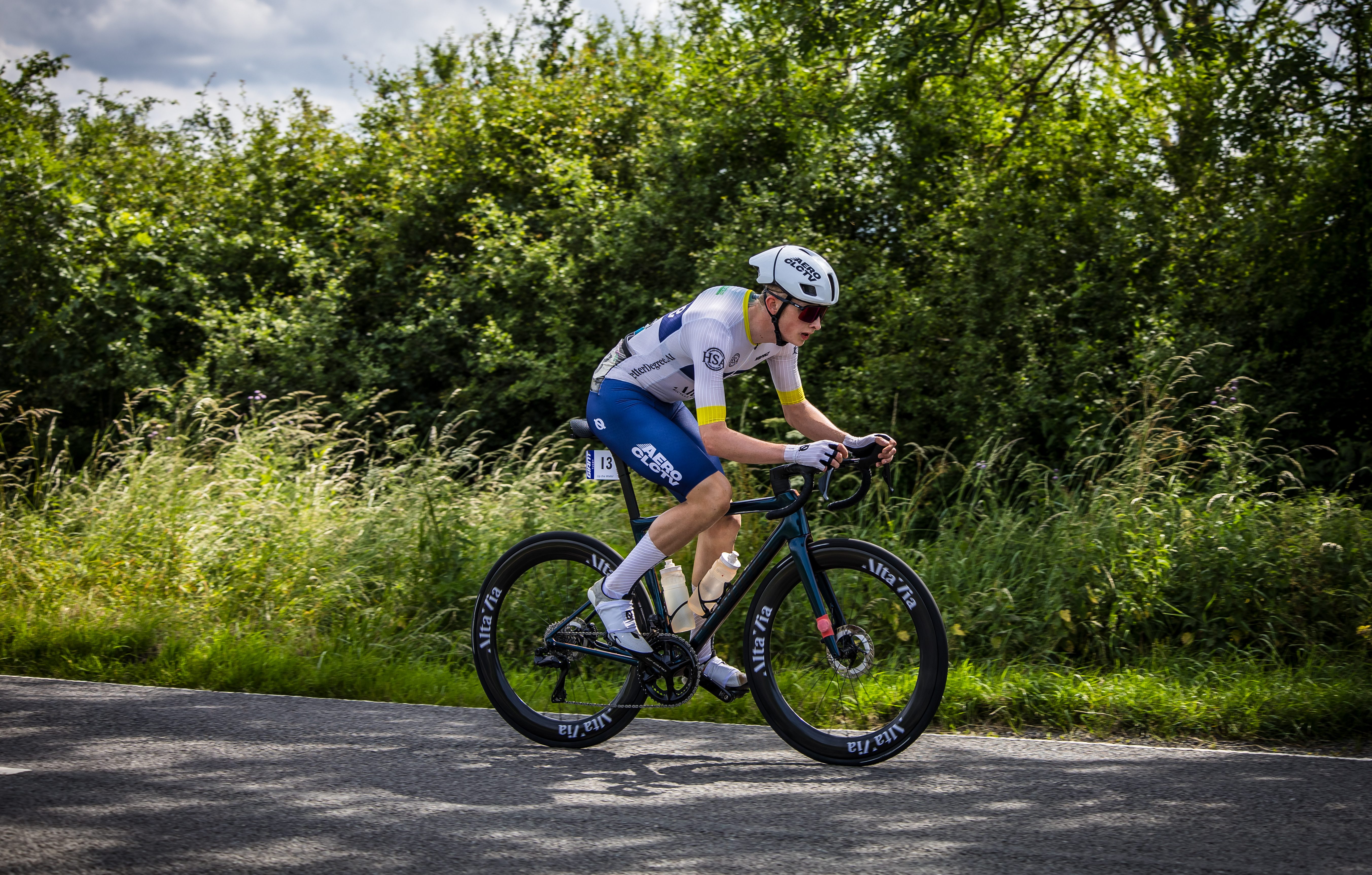
Can a 1.2-litre Skoda carry five bikes on its roof? This is something Elliott Colyer has been wondering as Aero CLCTV prepare to run a team car at National A races next year, one of many practical questions facing the Hampshire team as it steps up in 2027 after its first season.
The team launched in November 2025 with six riders and two aims. The first was to race the Tour of Britain by 2030, with a rider-led team run, in Colyer’s words, “as a business”. The second was to help rebuild the domestic sport around it: to put on the races its riders wanted to ride, and to use an Instagram account that predated the team to bring newcomers towards racing. “We want to be part of growing the pie,” Colyer and co-founder Alex Stanley said at the team’s launch, “not fighting over smaller slices.”
In 2027 the squad grows to 12, among them Sam Nisbet, 4th at the Peak 2 Day this year, Archie Peet, a former BUCS road race champion, and George King, a 33-year-old former distance runner who has never ridden a bunch race. Matt Downie, who will continue to race, becomes team manager and directeur sportif. The ambitions grow with the squad: a team at every round of the National Road Series, with entries and accommodation paid for by the team, more racing in Belgium and France including UCI 1.2 and 2.2 races if the invitations come, National B wins and a first National A podium.
Yet one ambition has already been deferred. In September 2025, Colyer said that securing British Cycling Elite Development Team status for 2027 “feels achievable”. Aero CLCTV will not be applying.

What the first season taught them
The first season tested both aims. On the bike, by the team’s own count, 2026 brought 22 wins and 46 podiums. Most came in regional and National B racing, and the best of them were Colyer’s. He won the Totnes–Vire Two-Day in April, attacking alone on the Jacobstowe circuit, and finished 8th in The British Continental’s national rankings, in which the team was 10th. Archie Wright won the opening stage of the Clive Tiley Memorial alone, then lost the overall lead on Harptree Hill the next day and finished 3rd.
At National Road Series level, the picture was different. The series is the top tier of British domestic road racing, the National A races where Elite Development Teams and the strongest domestic squads meet. Aero CLCTV riders started three of its seven open rounds in 2026, at Lincoln, the Tour of the Reservoir and South Molton, with Colyer’s 8th at South Molton the team’s best finish.
Off the bike, the year was fuller. When the Royal Navy Cup was cancelled in February, the team took it over within days and ran it on the airfield at RNAS Merryfield. The ZigZag Hill Climb ran for a second year. From 31 August the riders rode all five stages of the Tour of Britain, around 900km, two days ahead of the professionals, filming as they went, a project Colyer says brought in brands beyond the team’s season-long partners. Alongside the training tips and race explainers that make up most of the team’s feed, Colyer wrote for this site in July on the incentives created by British Cycling’s points system. The Instagram account, around 5,000 followers when we first wrote about the team in September 2025, is now nearly 7,000. None of that appears in a results table, which, for Colyer, is partly the point.
With a squad of six or seven you notice every single absence.
Speaking to The British Continental alongside Downie, Colyer is careful when asked whether the first season had proved the concept. “I’d say it’s ‘started to prove’ rather than a fully proven concept,” he says.
Part of what it taught them was that six riders were not enough. “It’s amateur domestic racing, no one’s getting paid to do it, so people have birthdays, someone’s injured, whatever,” Colyer says. “With a squad of six or seven you notice every single absence.” Twelve riders should mean a team at every race from February to September, with each rider’s season planned in advance, “so we don’t have everyone wanting to be flying at Portsdown, and then in August you’re looking around asking who still wants to ride the bike.”

The other lesson was about Elite Development status. Among British Cycling’s published requirements for 2026 are that every rider on an Elite Development Team holds an Elite, first or second category licence, that at least 30 per cent of riders on a men’s team are under 23, and that the team rides at least 80 per cent of the National Road Series. In return the team gets guaranteed entry for up to eight riders at every National Road Series and National Circuit Series race. Colyer says Aero CLCTV ticks many of the boxes, but some of its riders, King among them, do not meet the licence requirement.
If you’re being pragmatic about the scene, where National As aren’t oversubscribed, it’s not as essential as it was in previous years
That makes it partly a matter of eligibility. But Colyer and Downie also present it as a choice. Colyer argues that the guaranteed entries are worth less than they were. “If you’re being pragmatic about the scene, where National As aren’t oversubscribed, it’s not as essential as it was in previous years,” he says. It is a revealing observation about the state of domestic racing. Downie goes further. “Instead of pushing for it and getting the status without feeling we’re ready, we take a step back, swallow our egos a little, rather than saying ‘well, we did say this’,” he says. “Maybe in 2028 we’ll be completely ready, instead of half-ready and falling at the first hurdle.”
In the meantime the team will try to provide much of what the status brings. It aims to field a squad at every National Road Series round, with a team budget that will cover that programme, including entries and accommodation. “Get yourself there, or into a carpool with someone else, and your accommodation and entries are paid for,” Colyer says.
The team has been unusually open about the scale of those costs. On Friday the team posted on Instagram its own estimate of what the 2026 season cost: £27,446 across seven riders and 146 race days between them, or £3,921 a rider, once race entries (£4,860), accommodation (£3,146), fuel and Channel crossings (£4,150), kit, nutrition, maintenance, insurance and licences were added up. The figures mix actual spending with estimates and include what riders paid themselves, so they are not the team’s operating budget but, in its words, “an informed estimate of what it actually costs to go racing”. With 12 riders and more racing abroad, “things are about to get considerably more expensive”, the post says. Colyer’s estimate for 2027 is £50,000 or more.
The people behind the changes
Much of the 2026 team has gone. Alex Stanley, who founded Aero CLCTV with Colyer, has stepped away, as have Oscar Hoult, who won the South Region League, Charlie Palmer, and Bobby Buenfeld.

Stanley’s accountancy firm, Harvey Stanley Accountants, was on the team’s jerseys. Colyer says the firm’s growth was a large part of the decision. “Part of it is time pressure from lots of different avenues, and by stepping away he gains more time to focus on growing that,” he says. “But quite a lot goes into those sorts of decisions.” The firm will not sponsor the team in 2027, and Stanley will have no role.
Buenfeld’s move is the more telling one. He is 19, was 3rd at the Chitterne Road Race and 9th in the Stourbridge CC National U23 Road Race, and joins Stolen Goat 4Endurance, an Elite Development Team. Colyer says the team’s response was “well done, you’ve had a great season, go for it”. It is also what the team said in 2025 that it was for: “a platform for younger local talent to come through and hopefully move on to bigger and better teams”. The traffic is not all one way, however. Peet and Max Duckworth arrive from O’Neills Spirit Racing Team, which is also an Elite Development Team.
Everyone who’s there has made an active decision to join. A lot of them like being in a team which has the 2030 goal and a trajectory of growth
Why did riders choose Aero CLCTV over elite teams? Colyer thinks the team’s youth is part of its pull. “Everyone who’s there has made an active decision to join,” he says. “A lot of them like being in a team which has the 2030 goal and a trajectory of growth.”
Aero CLCTV 2027: ins and outs
In: Joe Bearman (League-Fortè Chiropractic), Patrick Crump (unattached, formerly Charlotteville CC), Max Duckworth (O’Neills Spirit Racing Team), Josh Hall (Nopinz RT), George King (Velo Club Venta), Nick Makin (Mid Devon CC), Sam Nisbet (Team Tactic U23), Archie Peet (O’Neills Spirit Racing Team), Brion Thomas (Team Pau)
Re-signed: Elliott Colyer, Matt Downie (team manager and directeur sportif), Archie Wright
Out: Bobby Buenfeld (Stolen Goat 4Endurance), Oscar Hoult, Charlie Palmer, Alex Stanley (co-founder, stepping away)
The signings mix established results and potential. Nisbet is the signing with results: 4th overall at the Peak 2 Day, 5th at the Mennock Pass Stage Race and 6th at the Yorkshire U23 Classic for Team Tactic U23. Peet won the PB Performance Espoirs in 2024 and the BUCS title in 2025 before a quieter 2026. At the other end of the scale, Brion Thomas, a first-year under-23, approached the team himself; Colyer spoke to his coach, “who was basically singing his praises”, and sees “an engine that is being developed”.
King’s route in is the least conventional. He is 33, the oldest rider on the team, and has never ridden a British Cycling bunch race. For more than a decade he was a distance runner, with bests of 14:44 for 5km, 67 minutes for a half marathon and 2:23 for a marathon, and nine marathon finishes from ten starts. “Running was taking its toll on my body and I wasn’t able to train as much as I would like,” he says. “I started cycling when I was injured and eventually realised I was having more fun on the bike.” Giving up competition left him in “a bit of a limbo period”. “I told myself I didn’t need it and I was done, but when I started getting fitter on the bike it lit that fire in me again. It made me feel like myself again.”

He switched properly last year and began racing this year, all of it against the clock: 3rd in the RTTC National Road Bike Championship in June, 19 minutes 42 seconds for 10 miles on a road bike, wins in the road bike categories of the Goodwood and Thruxton time trial leagues, and on 11 October the road bike title and 16th overall at the national closed circuit championship at Thruxton. He has four podiums from five hill climbs this autumn but, so far, he only knows bunch racing from his local chaingang. “I’m still relatively new to the cycling world, but competing as a runner for over ten years taught me a lot about preparing for races, nutrition, managing training and fatigue, and handling the pressure you put on yourself,” King says. “That goes a long way in any sport.”
Holding the team all together will fall partly to Downie next year. He is 29, raced for the Holdsworth UCI Continental team in 2018 and for TAAP until this year, and has never directed a race. He will race on, but does not expect to compete at the front of National As. “I want to be part of the team, but I know I won’t have the ability to do well in these national races. What I do have is the experience, and I guess the respect of the riders, to direct them in the way we need to go.”
I’ve never been a DS before, so it’s going to be a learning curve
He will lead the team car at the National Road Series; who sits beside him is still to be confirmed. “I’ve never been a DS before, so it’s going to be a learning curve,” he says. “I’ve been in team cars before. I know the ins and outs and the format of racing, so I have that behind me. I’m looking forward to getting stuck in, learning from mistakes, figuring out what works well, and helping the lads achieve as much as they can.” The motivation is personal. “Early in my career I never really had anybody to direct me or give me advice in races, so it’s something I’d like to give other riders, to give them the best opportunity to reach their goals in cycling,” he says.
He remembers Holdsworth as “very closed off and very cut-throat”, and wants Aero CLCTV to be the opposite. “People like the collectiveness of it all, the family dynamic: it’s basically mates racing bikes together,” he says. “There are set goals, but there’s no pressure from the team.” Colyer says Downie is already setting that tone. “I’ve got so much trust in Matt, from the bits and pieces he’s already naturally stepped up to this year,” he says. “A lot of the guys have said they just want a fun team environment, and you always have better legs when you’ve got good morale.” Downie’s own example of what advice can do is Wright. “Archie has a lot of power, but racecraft was one of his weaknesses,” he says. Wright was “very receptive”, and the Clive Tiley stage win in August was, in Downie’s account, the result.
The next step towards 2030
The ambitious Tour of Britain target remains. “You’ve got a short runway to 2030,” Colyer says, “so it’s easy to go into every year saying this is an important year to get right.”
What 2027 is meant to add is experience at a higher level: the full National Road Series, more racing in Belgium, French Elite races, and UCI 1.2 and 2.2 races if invitations come. Belgium, Colyer says, “gives you closed roads. It’s a different type of racing, more like continental racing, and that’s a chance for riders to really kick on and develop.” Downie thinks the value lies as much in confidence as in results. The team took Wright to race kermesses in Belgium this year, where he was 19th at Opdorp. “A lot of people go over to Belgium and they shit themselves,” Downie says. But once you adjust, he says, “You think, well, if I can do well in a Belgian race, I can do pretty well anywhere.”

The trips abroad are funded differently from the National Road Series: riders will pay their share of the direct costs, with travel and accommodation arranged collectively to keep them down, and prize money from those races will go into a pot to pay for the next trip. “I think it’ll motivate the team to work as a team,” Downie says, “and it also helps riders who can’t quite afford it to still attend these races.”
Asked afterwards what a successful 2027 would look like, Colyer sets the bar high: “establishing Aero CLCTV as one of the leading domestic teams, finishing in the top three of The British Continental team rankings, consistently placing riders in the results at National A and National B level, securing National B wins and challenging for our first National A podium.”
The team was 10th in this year’s rankings with 572 points; the three teams above 1,200 were Ride Revolution Coaching, JAKROO Handsling Racing and Wheelbase CabTech Castelli. He also wants the team to feel like one: “riders training together, supporting one another and feeling that they are part of something collectively, rather than simply appearing in the same kit at races.”
The route beyond that is the one set out at the launch. UCI Continental status, Colyer says, is how the team sees itself reaching the Tour of Britain, a race that can invite Continental teams but is not obliged to. Elite Development status in 2028 appears to be the step before it.
Races, audience and results
Race organising is the other half of the original mission, and the first year taught lessons there too. The Royal Navy Cup, the 120km National B the team rescued in February, will return to previous organisers, Team Tor 2000, in 2027. The handover came through Travis Bramley, the South West coordinator. “The plan at the start was to take it on again as Aero Collective next year, and then he said Team Tor were happy to take it back on,” Colyer says. “Given it was their event, I was very happy to keep it going for a year and then hand it back to them.” Bramley also suggested the team look at something closer to home.
I don’t necessarily want to be on the line for cars and other uncontrollable factors affecting the safety of riders in a race I’ve put on
That something is a race day of the team’s own at Thruxton. Colyer calls the plan “fairly speculative” and nothing is booked, but the model is the one-day stage race format used at Abingdon: a criterium, a time trial and a second criterium, “a good opportunity for points and a good level of racing”. There would be equal open and women’s races, support races, and stalls for the team’s partners, Alta Via among them. He points to the Lifetime series in America and the expo that surrounds Sea Otter. “Obviously we’re not going to do a whole expo, but moving a little in that direction, to make it a bit more than just the race itself.”

The National B road race in Dorset he described a year ago is on hold, and his reasons say something about what organising has taught him. A conversation at the ZigZag Hill Climb, about an under-23 national championship that once used the climb, has encouraged him that a race there could work. But the Royal Navy Cup was run inside the perimeter of a military base. “You have a closed circuit and a really controlled environment,” he says. “I don’t think road racing is too dangerous, obviously, because I race it myself. But I don’t necessarily want to be on the line for cars and other uncontrollable factors affecting the safety of riders in a race I’ve put on.” It is a question of admin and capacity, he says, not a judgement on those who do put on road races. “There are so many more complexities and chances for things to go out of your control.”
You need the sporting credibility to underpin it all
What the team can take on is also a question of money. The commercial model, as Colyer describes it, uses racing to build credibility and an audience, and the audience to attract support for more racing. Its Instagram account has almost 7,000 followers, and Colyer says reach and return on investment are the main thing sponsors are interested in, though “you need the sporting credibility to underpin it all”. The relationships built this year came, he says, from “the social media side, the stuff outside racing”, including the Tour of Britain project, and the lesson he takes into 2027 is to do more of it: “telling the story of the team, the riders, adding personality to the team, showing more of what goes on behind the scenes.” Alta Via are increasing their equipment support for 2027, and there is a first non-cycling partner, Manta Sleep.
Those partners are backing a bigger operation. By the team’s own estimate racing cost £27,446 in 2026; Colyer expects 2027 to cost £50,000 or more, with 12 riders, a team car and more racing abroad to pay for, and without Harvey Stanley Accountants on the jersey. He calls the off-the-bike growth and the budget “the elephant in the room”. “It isn’t necessarily linear,” he says of that growth. “It’s about exposing yourself to the chance of that happening.”
The team begins introducing its 2027 riders on Instagram on Wednesday.

Read the 2027 men’s domestic team guide here, and follow every rider move on Mercato 2027.