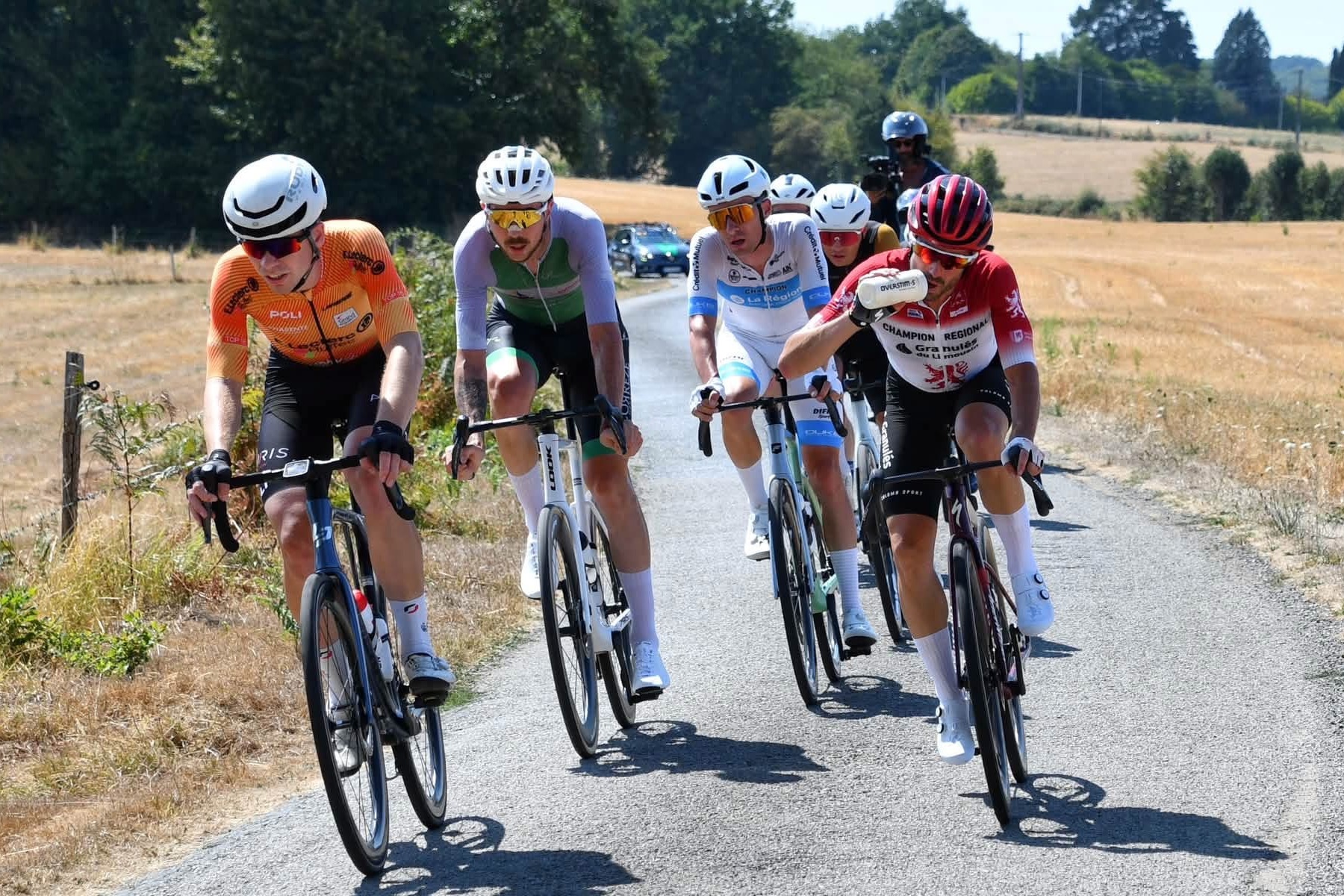
David Hird is a pathfinder. The 24-year-old from Worcester discovered road racing on the slopes of Box Hill during the 2012 London Olympics, and made it to the top of the UK scene with Cycling Sheffield. When The British Continental last caught up with him, he was about to move to France to link up with the N2 ESEG Douai team, located near the historic battlefields of World War One. After a fruitful season, he moved south to the Charente, becoming, he tells me, the first ever British rider at the N1 E. Leclerc Ruffec Top 16 team. In 2027 he will return to his new home from home, around 16 kilometres north of Angoulême. There he will be joined, living in apartments at the team’s service course, by two new British teammates.

Today’s journey is more straightforward: to make it to a coffee shop in the centre of Birmingham. Seems easy enough, but the October half-term holiday crowds and the modern labyrinth that is New Street station pose their own challenges. So, we are a little thankful when we separately emerge into the right part of the city to sit down and talk about David’s 2026, his return home for the off-season, and his hopes and expectations for next year.
We start with life in the Charente, the French department number 16 (hence the team’s name). It’s a very different part of France to Douai, which, as well as being near the Western Front, is close to France’s largest historical coal-producing area. Of his current base, David says, “I think it’s ideal training terrain really, because you’ve got enough climbs, but it’s not too hilly. It’s not too mountainous or anything and there’s great scenery there. It’s a really beautiful region. It’s only 30 minutes to Cognac from where I’m living. And so, yeah, you’re riding all around the vineyards.” What about living above the shop, so to speak, at the service course? “It’s a good place to live really,” he says. “It’s been brilliant.”

David won’t be the only Brit enjoying the roads and accommodation in 2027, as he will be joined in the team by Tom Williams and Ed Morgan. Williams, the most recent winner of La Gainsbarre, and Morgan, a multiple 2026 victor, both join from CC Villeneuve Saint-Germain. It won’t, though, be the first time that their paths have crossed. “In 2023 I was teammates with Tom Williams at SRCT [the now-defunct British team] and then I know that Ed was at SRCT in 2025, and I just know him really from the races.” David is happy to be reunited with the pair. “They’re both very good people and yeah, I’m looking forward to being with them on the team next year.”
I like to think I’m one of these people that can make the most of the experience alongside the racing
The annual rider merry-go-round means that there will be a total of eight new faces at the 14-strong Top 16 team, many of them young talents. How does David feel about being the voice of experience? “It’s a good role for me. I believe I can help those less experienced riders. For example, we’ve got riders coming up from juniors for their first year at under-23 and I believe I can use my experience to help those riders in races.” That this is even possible is a testament to how David has embraced the French language and lifestyle. “I’ve really enjoyed living in France,” he says. “And really enjoyed the French culture. I like to think I’m one of these people that can make the most of the experience alongside the racing. I’ve learned French. I’m by no means fluent, but I enjoy learning French and practising speaking.” We joke that the next challenge is to learn bad French, the kind that will allow him to comfortably kick back with his teammates in between their official duties. It’s a common thread among the young riders who go to France and not something that they can learn in a classroom.
What sort of a welcome can the newcomers expect from the team? If David’s own reception in early January is indicative, it will be a warm one. “The organisation has been brilliant, and yeah, they’ve been really welcoming and friendly. They are just a very dedicated team, very on it. And as an example, the day I arrived, two of the team managers were there to welcome me. And the day after, they showed me around the local area. There was a very welcoming atmosphere in the team. And I’d say the same for the teammates as well.”

We have been talking for a while, and I see that outside it is already dusk. The autumn sunshine is giving way to something altogether darker, and the venue is discernibly less busy. The baristas are spending more time chatting than making coffee and, truth be told, they look a little bored. We move on to David’s development and ambitions. How does he reflect on his 2026? The first thing he mentions is the heat. “It was definitely new,” he says. “I think I coped well. And a lot of the races were in like 30-plus degrees.” It’s the new reality of bike racing, we agree, and one that makes adaptation to high temperatures a key element of the skillset.
I think I’m quite good at being consistent and reliable in races
Digging into the results themselves, several things stand out. There is a consistency of performance across the 60 race days that made up David’s season. Without hitting the top step, he achieved multiple top-10 finishes. Then, there is the purple patch in late July and early August when he achieved eight of those results in just 10 races. How does David see all this? “I think I’m quite good at being consistent and reliable in races. I believe I’m suited to races with undulating terrain, sort of moderate amounts of climbing. And I think it’s generally a hard race [that suits me].”

That hot and busy summer is now becoming a memory, so what has it been like to be back at home? Primarily, he tells me, it’s been an opportunity to recharge the batteries and to re-engage with family and friends, and David is grateful for all the encouragement he receives. Recently his parents made the trip over the Channel to watch him race the Three Days of Cherbourg and he says, “I’ve had great support from my family.” Then there is the wider group of people he grew up with. “I’ve got a group of friends that I’ve known from college really and they’ve all been to university and stuff like that. But they’re very supportive of my cycling.” Crucially, it’s also a chance to top up the coffers. Like many others at his level, David works over the winter to support his summer dream. In his case it is with a well-known supermarket chain and over time his colleagues in the aisles have also joined David’s emotional support crew.

The racer’s short annual rest period is now coming to an end and, under the tutelage of long-time coach and former British under-23 champion Dan Fleeman (someone I was writing about as a young aspiring rider himself, some 20-plus years ago), things are slowly grinding back into life. Before we meet, David has already been out on his old rim-brake bike to do a couple of hours of zone two. He tells me that he is not a great fan of the indoor virtual training world and that the prescription for the next week or two is likely to be more simple outdoor riding. At some point the intensity will gradually begin to ramp up, but not quite yet. What off-season advances is David looking to make? “I’ve always been very focused on the training and so I’ll be talking to Dan, and we’ll be discussing what we can improve over the winter, but I’ve looked back at this season, and I’ve thought that I can improve on backing myself in moments in races. And even just that could make a big difference.” As we see so often, the distinction between a good and a great result can lie in belief as much as in form.
I’ve looked back at this season, and I’ve thought that I can improve on backing myself in moments in races
David also believes that he will be better for the experience he gained in 2026. This is based, in part, around the continuity of a second year with Top 16. For example, he is already able to look forward to a race calendar which holds few unknowns. “Having done 2026, you begin to learn every race, you learn a bit more about the patterns in races. And then you’re in a better position for next year.” What expectations does he have for 2027? “Like any rider, you always want more,” he tells me. “I know that I can improve my results and especially with all the experience I got this year. For example, this year I would have liked more podiums and wins, and I believe I can improve on that next year.”

Early January will bring a return to France, followed in short order by a training camp in southern Spain. They’re the next steps along the path and ones that David is looking forward to. Of the camp he says, “It’s a new place for everyone. So, it’s a good setting to meet teammates and different characters.”
His is a quiet flame, but a flame nonetheless
We look around and to our surprise the baristas are readying to close the place up for the day. The last hour has been spent just talking, sharing stories of people and places. Things we have in common. Turning the tables, David has asked as many questions as he has answered. He is both engaged and curious and gives off a quiet determination to just get better. His is a quiet flame, but a flame nonetheless. The afternoon has become early evening. The commuters are streaming for their trains and we decide to do likewise, following them back into the station and onto the vast domed concourse. But which way to go from here? We scratch our heads. Eventually we identify our trains and some time later escape from the river of people and onto our respective platforms. The right path, it seems, can always be found in the end.